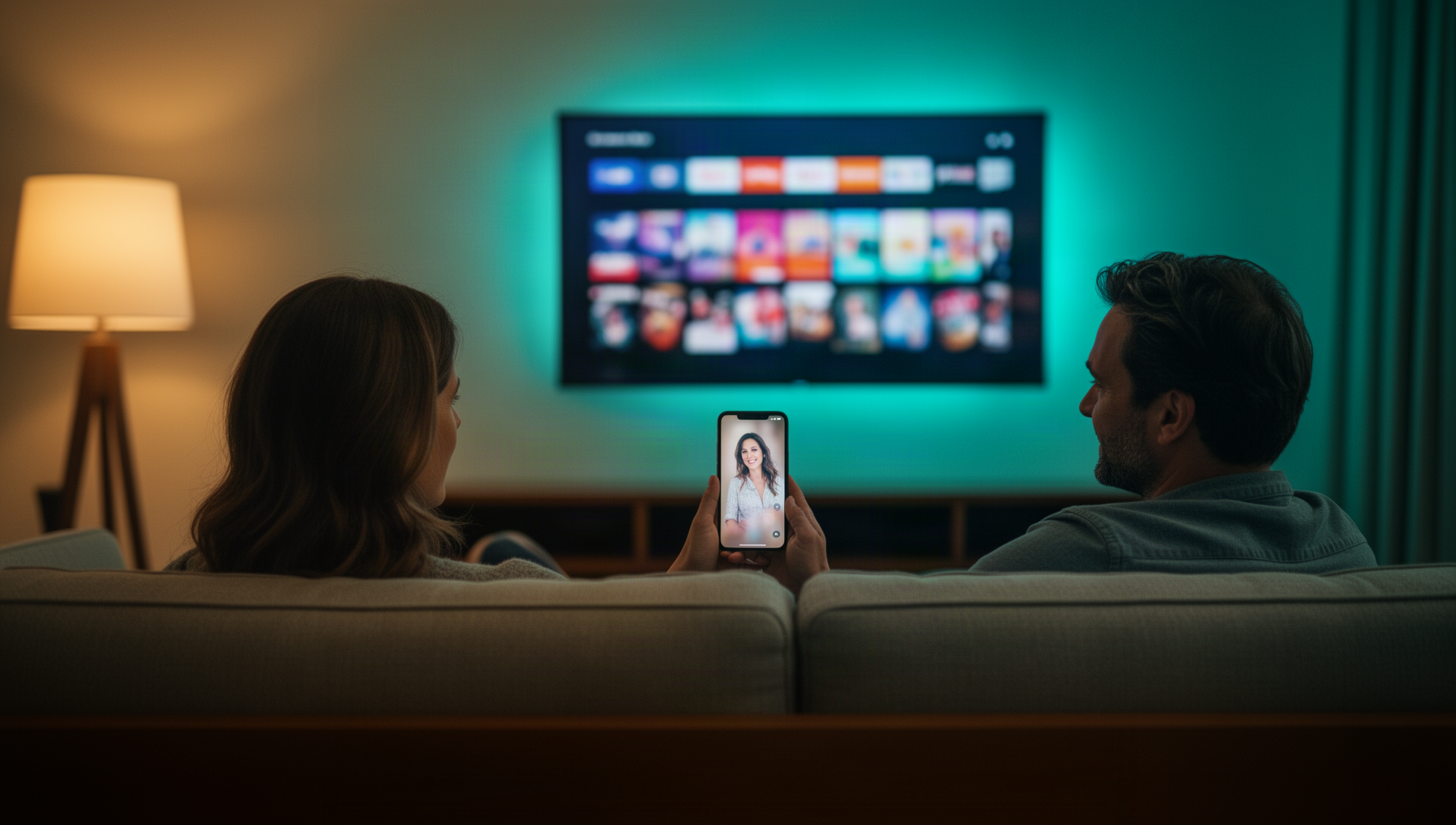
Social media and CTV (connected TV, the streaming ads people see on their smart TVs) work best as one campaign, not two. Roku’s 2026 white paper Social’s Big Screen Moment, produced with Publicis Media’s PMX and research firm MediaScience (652 US adults, 18 to 50), found that the same ad was more engaging in a social feed but more than three times as likely to be called annoying there than on the TV home screen. Showing one creator once in the feed and once in a CTV ad break made the brand read as more authentic (54%) than two exposures on social alone (34%), with no extra impressions bought. For challenger brands and hotels on fixed budgets, the lesson is practical: the lift only shows up when the same people, in the same markets, see both pieces of creative.
Most brands still plan these channels in separate rooms. Social gets a vertical video and a lookalike audience. Streaming TV gets a polished :30 and a national household target. Different creative, different audiences, different geographies, and then everyone wonders why the “integrated” campaign didn’t move the needle. Here’s our take: if you can’t afford to blanket the country (and almost nobody we work with can), the smartest dollar you spend is the one that makes your social and your CTV hit the same households with the same story.
- Why social and CTV are two halves of the same viewer
- What Roku’s 2026 white paper found
- Why relevance is the lever that drives purchase intent
- Why geography and audience alignment matter more on a small budget
- How hotel and challenger brands can put this to work
Why social and CTV are two halves of the same viewer
How much time do people spend on streaming and social?
Americans spend about 1.4 hours a day watching shows and movies on streaming services and 0.9 hours on social media, according to Deloitte’s 2025 Digital Media Trends survey. Those are the two biggest arenas of attention most brands can buy into, and they keep growing. Streaming reached 49% of all US TV viewing in July 2026, per Nielsen’s The Gauge as reported by TheWrap, while cable fell to a record low.
The money is following the eyeballs. The IAB’s 2026 video ad spend outlook projects US CTV ad spend at $29.3 billion this year and social video at $31.9 billion, nearly neck and neck.
Are people really watching TV and scrolling at the same time?
Yes. Nearly three in four US TV viewers regularly use their phones for other media while watching TV, according to Omdia research presented at IBC2026 and reported by TVTechnology. Second-screening is growing fastest among older viewers: 73% of 45 to 54 year olds now do it, up from 62% in 2023. Your guest isn’t a “social person” or a “streaming person.” They’re one person holding a phone in front of a TV. Plan for that.
Do influencers matter on the big screen too?
They’re starting to. Fifty-eight percent of US consumers say they’ve bought something because of an influencer endorsement, according to the 2025 Influencer Trust Index from BBB National Programs’ National Advertising Division. Creators already drive lower-funnel results on social, and CTV is now opening the ad break to them. (If you’re still running creators as one-off posts, we wrote about why that leaves money on the table.)
What Roku’s 2026 white paper found
How was the study set up?
For Roku’s official white paper, Social’s Big Screen Moment, MediaScience and its StreamPulse platform recruited a nationally representative at-home panel of 652 US adults aged 18 to 50 on behalf of Roku and PMX. Streamers either navigated the Roku home screen and watched a show with ads, or scrolled a curated Facebook feed with ads in natural positions. Two brands were tested across six cells: Celsius (a ready-to-drink energy drink) and the Panera loyalty program. Some participants saw an ad twice on social, some twice on CTV, and some once on each. Total frequency was held at two in every cell, which is what makes the comparisons fair.
Does the same ad perform differently on social versus CTV?
It does, and in opposite directions. With identical creative and only the screen changed, 28% of viewers called the ad engaging in the social feed versus 19% on the CTV home screen. But 14% called it annoying on social versus just 4% on CTV. Social buys attention; that attention comes with an irritation tax the TV home screen doesn’t charge.
What happens when the same creator appears on both screens?
The brand felt most authentic when viewers saw the creator once in their feed and once in a CTV ad break. That split earned a 54% “is authentic” rating, versus 45% for two CTV exposures and 34% for two social exposures. The 20-point gain over social alone was statistically significant; the 9-point gain over CTV alone was directional. Same creator, same campaign, same number of impressions. The only thing that changed was spreading them across two screens.
That’s the headline for anyone watching their budget. You didn’t buy more media. You bought smarter media.
Is this the only study that shows social and streaming work better together?
No, and that matters, because one study is a data point and two are a pattern. A November 2025 study from Comcast’s Universal Ads, also run with MediaScience, found up to 2.8x higher unaided brand recall when streaming TV and social ads ran together versus social only, and a 24% lift in purchase intent from adding streaming TV to a social plan. The kicker for challengers: emerging brands saw 2.3x more brand-perception lift than established ones. Both studies come from companies that sell CTV ads, so read them with that in mind, but they point the same way.
Why relevance is the lever that drives purchase intent
What actually moved people to want to buy?
Feeling that a product is “made for someone like me” was the single biggest driver of purchase intent in Roku’s white paper. In a regression across 650 respondents, that relevance attribute carried more than 3x the weight of the next-strongest attribute (a standardized beta of 0.436 versus 0.137), and it held across both brands and every age group. Roughly, every step up in feeling personally relevant came with a matching step up in wanting to buy.
Does moving content from social to CTV raise relevance?
In this study, it did. When Celsius’s made-for-social ad ran as a Roku home screen placement instead of in the feed, “for someone like me” jumped 17 points (19% to 36%) and purchase intent rose 11 points (22% to 33%). When the creator for Panera’s loyalty program appeared in a made-for-CTV mid-roll instead of a made-for-social post, relevance rose 20 points (26% to 46%) and purchase intent rose 14 points (18% to 32%). All four lifts were statistically significant.
Why does this matter for hotel marketing?
Because “made for someone like me” is the whole game in hospitality. A traveler isn’t choosing between room types; they’re choosing which version of their trip feels like theirs. The couple planning a long weekend, the golf buddies, the family looking for a pool and a quiet room: each needs to see themselves in the creative. That’s the same emotional logic we covered in emotional branding in tourism. Social tells you which “tribe” is raising its hand. CTV gives that tribe the big-screen version of the same promise.
Why geography and audience alignment matter more on a small budget
Why do the same people need to see both pieces of creative?
Because the cross-screen lift only happens inside the overlap. In Roku’s white paper, the authenticity bump came from one person seeing the feed post and the ad break. If your social campaign targets lookalikes in Dallas and Atlanta while your CTV runs nationally against a broad demographic, very few people see both. You pay for two campaigns and get the results of two separate, smaller ones. The studies above measure what happens when the overlap exists; nobody has yet published a head-to-head test of matched versus mismatched geographies, so this is the logical conclusion of the research, not a separate finding.
Why is this especially important for challenger brands?
A challenger can’t outspend the category leader everywhere, but it can outspend them somewhere. The classic share-of-voice rule from the IPA’s effectiveness work says that when a brand’s share of advertising voice exceeds its share of market, it tends to grow (explained here by Westwood One). Concentrating social and CTV in the same few markets is how a smaller budget gets a louder voice where it counts. It’s not the size of the budget, it’s how you use it. (Phrasing.)
Does geo-focused CTV actually work for hotels?
One documented example says yes. In a Madhive case study, a national hotel and resort chain ran a localized Northeast campaign (Massachusetts, Connecticut, Rhode Island, and the New York metro) across CTV, mobile, and tablet video. It delivered a 10% lift in average booking revenue on a budget 64% smaller than the chain’s 15-state national effort. Fewer markets, more pressure in each, better results.
How hotel and challenger brands can put this to work
Where should a hotel start?
Start with your feeder markets. Your booking engine and PMS already tell you which ZIP codes and metros send you guests. Those markets become the shared geography for both social and CTV. Then build the audiences from the same source: upload your CRM list to Meta as a custom audience, match it to households in your CTV platform, and build lookalikes from the same seed on both sides. Now your “tribes” are the same tribes on both screens.
Does a hotel need a big TV production budget?
No. The study’s home screen cell used an ad built for social, and it still raised relevance and purchase intent. Roku has even released a tool to turn social ads into CTV ads. Shoot once with both screens in mind: a vertical cut for the feed, a horizontal :15 or :30 for the ad break, and a static or short-form version for the home screen. That’s the same “build once, publish everywhere” approach from our video-first content strategy and guide to repurposing content.
Which screen should do which job?
Let each screen play to its strengths and keep the story consistent. Here’s how we split the work:
| Placement | Its job | Watch out for | Hotel example |
|---|---|---|---|
| Social feed | Grab attention, find the tribes that respond, drive clicks | Higher annoyance (14% vs. 4% on CTV); fatigue at high frequency | Creator’s weekend-stay reel targeted to feeder-market lookalikes |
| CTV home screen | Low-irritation reach that lifts relevance and quality perception | Needs a clear, simple visual; there’s no sound to carry it | Hero image plus offer, shown in the same ZIP codes |
| CTV ad break | Sound and motion that build credibility and purchase intent | Generic national demos that miss your actual guests | Same creator in a :30 walking through the property |
| Both, coordinated | Authenticity and relevance neither delivers alone | Mismatched markets, audiences, or messages | One creator, one offer, one set of markets, one flight |
How do you measure whether it’s working?
Measure the combination, not each channel in a silo. Household-level CTV attribution can match exposed homes to site visits and bookings, which you can then compare against your social and analytics data. When we tested this for our own clients, running traditional digital and OTT together increased performance by more than 70%, while OTT alone created a 12% lift and traditional digital alone a 43% lift (details on our OTT/CTV advertising page). On the social side, track reach, saves, shares, and DMs rather than follower counts, as we covered in how to measure social media success. And remember that what happens after the click depends on your site too; here’s what marketing does and doesn’t control in hotel conversion rates.
What does this look like in practice?
Our Margaritaville at Sea OTT case study is a good example. Margaritaville at Sea was a newer cruise line competing against brands with bigger fleets and bigger budgets, a textbook challenger. Rather than buying broad reach, we built the audience from behavioral and demographic signals and overlaid audience insights from our work as Agency of Record for Margaritaville Hotels & Resorts, so the people seeing the streaming ads were the same kind of people already raising their hands elsewhere in the Margaritaville ecosystem. Using Madhive’s tracking, the campaign delivered a $15.30 combined OTT CPM, a 14:1 trackable ROAS, $0.71 per visit to the booking engine, and a $63 cost per new customer.
That’s the advantage of longstanding partnerships. Phrasing has been a long-time partner of Roku and Madhive for our OTT/CTV advertising and DSP services, which gives our clients access to premium inventory, household-level targeting, and attribution that a brand buying on its own usually can’t get at the same price.
Final thoughts
Social and CTV aren’t competing for your budget. They’re doing different jobs for the same person. Social engages harder; CTV irritates less and makes your brand feel more relevant and more credible. Roku’s 2026 white paper shows the payoff comes from coordination: the same creator, the same message, split across both screens, with no extra impressions. For challenger brands and hotels, that payoff depends on discipline. Pick your markets, define your tribes once, and make sure the people who see your reel are the same people who see your ad break.
Ready to make your feed and your ad break work as one campaign? Contact Phrasing to build a social and CTV plan aimed at the markets and guests that actually book.
Key Takeaways
Is it better to run the same ad on social and CTV, or pick one?
Run both, coordinated. In Roku’s 2026 white paper with PMX and MediaScience, one creator exposure in the feed plus one in a CTV ad break produced a 54% authenticity rating, versus 34% for two social exposures and 45% for two CTV exposures, at the same total frequency.
Why do social ads feel more annoying than CTV ads?
Ads in the feed interrupt active scrolling. With identical creative, 14% of viewers called the ad annoying on social versus 4% on the Roku home screen, even though social scored higher on engagement (28% vs. 19%).
What drives purchase intent across social and CTV?
Relevance. Feeling a product is “made for someone like me” carried more than 3x the weight of any other attribute in predicting purchase intent, and moving content to CTV raised that perception by 17 to 20 points.
How should hotels target social and CTV together?
Use the same feeder markets and the same audience seeds on both screens. Build from booking and CRM data, match to households for CTV and custom audiences for social, and keep the creator and offer consistent so the cross-screen lift lands on the same guests.
Can a challenger brand afford CTV?
Yes, when it’s focused. Concentrating spend in fewer markets raises share of voice where it matters, and Phrasing’s Margaritaville at Sea campaign delivered a $15.30 OTT CPM and a 14:1 trackable ROAS by targeting the right audience instead of the biggest one.